Why did the Congo crisis happen?
Topic of Study [For H2 History 9174 Students]:
Paper 1: Conflict and Cooperation (1945-2000)
Section B: Essay Writing
Theme III Chapter 4: Intra-State Conflicts [Congo Crisis, 1960-1965]
Historical context: The decolonisation of Congo and the Mutiny
On 30 June 1960, Congo was no longer under the control of the former Belgian colonial power, achieving independence on this historic day. Less than a week later, Congolese forces in Force Publique mutinied against their Belgian commanders. The mutiny began in Thysville military base before spreading to the rest of the Congo Republic.
The mutineers made three demands: The removal of the Belgian commander in chief General Emil Janssens, the replacement of all Belgian officers by Congolese and raise in pay and rank.
Prime Minister Patrice Lumumba tried to end the mutiny but to no avail. He conducted a large-scale promotion, advancing every Congolese soldier by one grade.
The racial stratification that marked the pre-independence Congo clearly applied to the Force Publique. Whites controlled and composed the officer corps. The highest rank to which Africans could aspire was that of sergeant-major.
An excerpt taken from the “Anatomy of Rebellion” by Claude E. Welch Jr. (1980).
The Belgians, similar to other governing alien minorities, believed their rule best protected by compliant troops schooled in instant obedience, and by culturally homogenous commissioned officers sharing in full the assumptions and views of the dominant group. […]
The precipitating incident was General Emile Janssens’ proclamation to restive troops, “Before Independence = After Independence.”
Over time, violence spread to other parts of the Congo, prompting the departure of the Europeans. In response, the Belgian government deployed its troops to restore order and safeguard the well-being of its Belgian citizens. However, this move antagonised the Congolese central government as its leaders were not being consulted with.
Lumumba sent a plea to the United Nations in hopes of receiving operational support to pressure Belgium to withdraw its forces from the Congo.
On 14 July 1960, the United Nations Security Council passed Resolution 143, authorising the creation of a peacekeeping force known as Organisations des Nations Unies au Congo (ONUC, or UN Mission in the Congo).
The secession of Katanga
In addition to the problem of Belgian presence in the Congo, the nation had to contend with another serious issue: the secession of Katanga and South Kasai. On 11 July 1960, Kantaga declared its independence from the Congo Republic. A month later, the South Kasai province followed suit (9 August 1960).
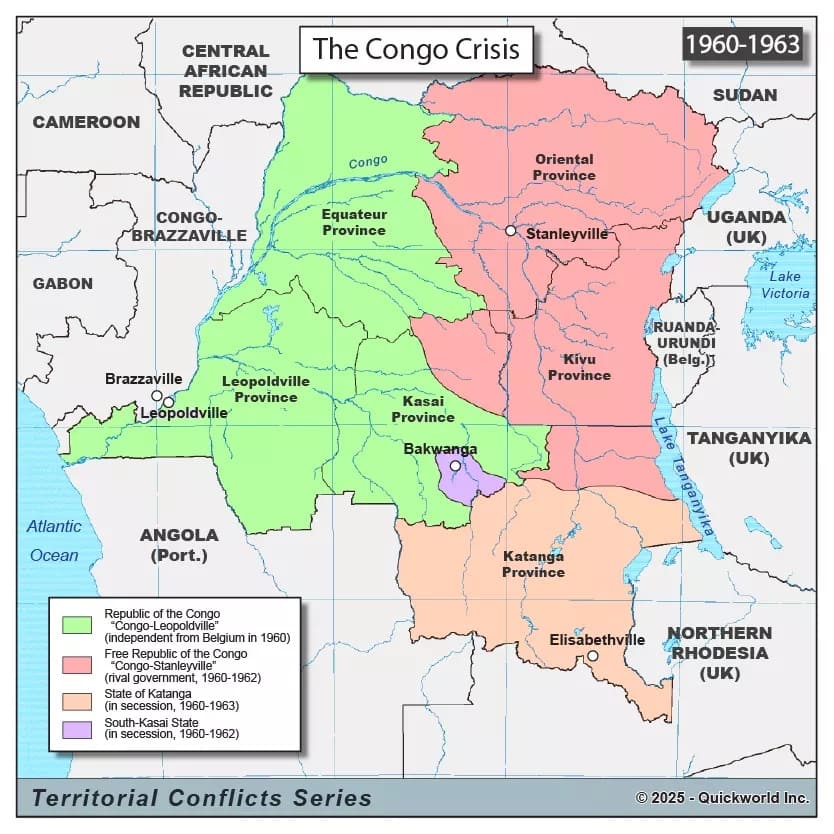
The Katanga province was known for its mineral-rich status, featuring minerals like copper, cobalt and uranium. The Belgian mining company Union Minière du Haut-Katanga (UMHK) conducted its mining operations in Katanga, enjoying an annual turnover of about $200 million in USD in 1960.
Even before independence, Katanga experienced growing separatist tendencies. The mutiny incident become a trigger to reverse the opposing stance by the Europeans that saw secession of Katanga as an opportunity to protect Belgian investment.
The province’s president, Moïse Tshombe, sought help from Belgium and other Western states to oppose the spread of communism in central Africa. Also, Belgian troops deployed in Katanga helped to maintain order within the province.
With independence, the Europeans in Elisabethville saw a chance to stem the tide of African independence and supported the secessionist government of Moïse Tshombe. Belgium as well would lend Tshombe’s rebel government unofficial support, as Katanga continued its mission of remaining separate from Congo-Léopoldville.
An excerpt taken from “Congo” by Sean Rorison (2008).
The Belgians would secretly fund the mercenary army that gave ONUC a run for their money; the possibility of losing control of UMHK and the numerous lucrative mines scattered across the province was an unattractive option for European interests in Katanga.
The secession of South Kasai
Between 1960 and 1962, the leader of the MNC-K party Albert Kalonji fought to secede South Kasai from the Republic of the Congo. Like Katanga, South Kasai received assistance from Belgium.
More importantly, the secession in South Kasai was influenced by the ethnic tensions between the Baluba community (represented by Kalonji’s MNC-K) and the Bena Lulua.
In this phase, Kalonji became President of the South Kasai province and Joseph Ngalula assumed the role of Prime Minister. Kalonji’s rule was bolstered by the Luba chiefs. He established a strong narrative that the secession was justified because of ethnic persecution and the inability of the Congolese central government to safeguard the interests of the Baluba people.
Join our JC History Tuition to learn more about the Congo Crisis under the theme of Conflict and Cooperation. The H2 and H1 History Tuition feature online discussion and writing practices to enhance your knowledge application skills. Get useful study notes and clarify your doubts on the subject with the tutor. You can also follow our Telegram Channel to get useful updates.
We have other JC tuition classes, such as JC General Paper Tuition. For Secondary Tuition, we provide Secondary English Tuition, Secondary Math tuition, Secondary Chemistry Tuition, Social Studies Tuition, Geography, History Tuition and Secondary Economics Tuition. For Primary Tuition, we have Primary English, Math and Science Tuition. Call 8929 2422 to find out more.