Tag Archive for: bosnia

What Happened in the Siege of Sarajevo?

Examine the historical significance of the siege to understand its implications on the Bosnian War. [Video by Radio Free Europe/Radio Liberty]

Historical context: The Liberalisation of BiH
In February 1992, a ‘Referendum Weekend’ was scheduled as a requirement to recognise the independence of Bosnia and Herzegovina (BiH). While the Bosniaks and Croats supported the referendum, the Serbian Democratic Party (SDS) – led by Radovan Karadžić – boycotted said referendum. The SDS rallied the Bosnian Serbs to support its stance.

The SDS was against the referendum because it feared that independence of BiH would turn the Bosnian Serbs into a minority, violating their interests to remain part of Yugoslavia.

Of the three (communities), Bosniacs were the strongest proponents of a sovereign unitary state. While open to Bosnian sovereignty, Croats preferred cantonization. For their part, Serbs preferred for BiH to remain within the FRY; their second-best option revolved around the right of Serb areas to seek secession and rejoin the FRY. Not only did the three communities broadly disagree, Serbs considered the birth of independent BiH illegal because of the fact that the referendum on independence had gone ahead in spite of the boycott of one of the constituent people.

An excerpt taken from “When the Total is less than the Sum of the Parts: The Lessons of Bosnia and Herzegovina” by Marie-Joëlle Zaha.

Eventually, BiH declared independence from the Socialist Federal Republic of Yugoslavia (FRY) on 1 March 1992. On that same day, a shooting incident occurred.

The Baščaršija shooting incident
During a Bosnian Serb wedding procession in the Baščaršija district of Sarajevo, a Bosnian paramilitary member, Ramiz Delalic, killed the groom’s father and wounded an Orthodox priest. The attack sparked tensions over the display of Serbian national symbols during the wedding.

The Bosnian Serb community was outraged by the shooting, viewing the attack as a deliberate act of ethnic violence, giving rise to mobilisation and the setting up of barricades across Sarajevo. This incident highlighted the emergence of inter-ethnic violence.

According to a report by the CSCE, the blockade of the city ‘turned from spontaneous protests provoked by the wedding incident to an SDS-controlled effort’. Thus the barricades appeared not simply to ‘protect Serbs’ in the wake of the Baščaršija shooting but to demonstrate that the SDS would not accept lightly a declaration of independence in the event of a ‘yes’ vote.

An excerpt taken from “Reporting the Siege of Sarajevo” by Kenneth Morrison and Paul Lowe (2021).

The Siege
Bosnian Serb forces seized the capital city of Sarajevo, starting a four year-long brutal campaign that terrorised the citizens within. Sarajevo was under siege on 5 April 1992, trapping inside the city.

From May 1992 onwards, Serb forces attacked civilian areas of the city, resorting to shelling and sniping to wreck havoc on the population. Consequently, casualties mount. Between 1992 and 1995, more than 13,000 people had died, including 5,000 civilians. Much of the infrastructure in Sarajevo was damaged or destroyed, including religious buildings.

In early 1993, the Serb forces attacked the Cerska area in eastern BiH, forcing thousands of Bosniaks to flee to UN-declared ‘Safe Areas’.
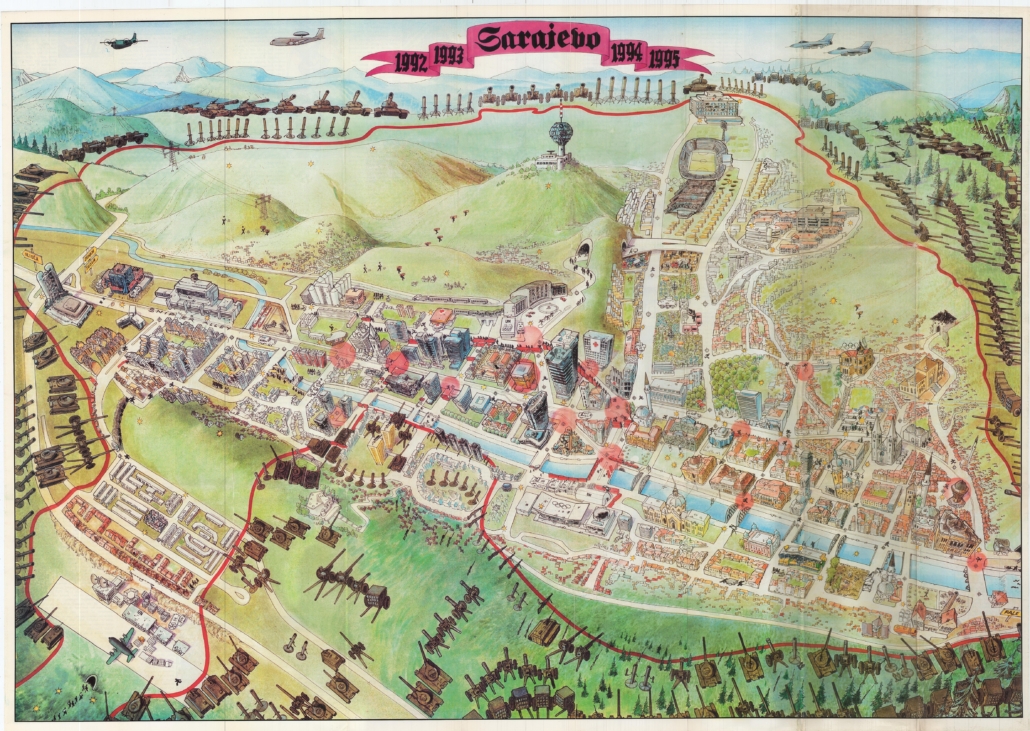
A survival map provided by FAMA International that documented the Siege of Sarajevo and the disintegration of Yugoslavia.
A survival map provided by FAMA International that documented the Siege of Sarajevo and the disintegration of Yugoslavia [From David Rumsey Historical Map Collection]

Markale Market massacres
On 5 February 1994, the Army of Republika Srpska (VRS) fired a 120mm mortal shell into the Markale marketplace in Sarajevo, killing 68 people and injuring almost 200. On the same day, the Bosnian Serb leadership blamed ‘authorities in Sarajevo’ of planting explosives to influence the international community to blame the Serbs for the atrocities. A UNPROFOR report revealed that about 40 projectiles were fired from Serbian positions around Sarajevo on that day.

On 28 August 1995, five mortar shells hit the Markele market, killing 43 and injuring at least 70. A 1999 report to the UN concluded that the VRS was responsible for the second attack as well.

Conclusion
In December 1995, the Dayton Agreement was signed, ending the Bosnian War. On 29 February 1996, the Bosnian government declared the end of the siege.
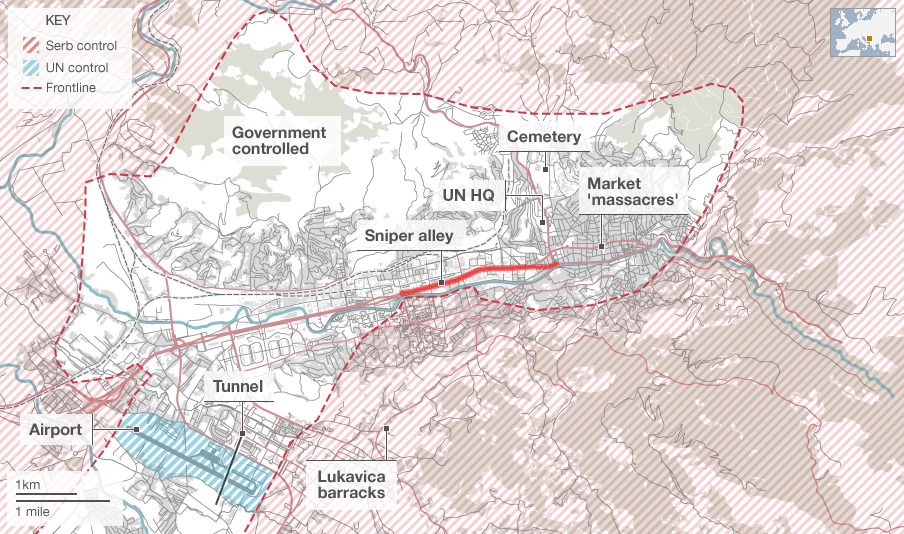
A map that illustrates the front lies around Sarajevo, highlighting areas controlled by the United Nations as well as the Serbs. [Map by BBC]

Join our JC History Tuition to learn more about the Bosnian War under the theme of Conflict and Cooperation. The H2 and H1 History Tuition feature online discussion and writing practices to enhance your knowledge application skills. Get useful study notes and clarify your doubts on the subject with the tutor. You can also follow our Telegram Channel to get useful updates.

We have other JC tuition classes, such as JC General Paper Tuition. For Secondary Tuition, we provide Secondary English Tuition, Secondary Math tuition, Secondary Chemistry Tuition, Social Studies Tuition, Geography, History Tuition and Secondary Economics Tuition. For Primary Tuition, we have Primary English, Math and Science Tuition. Call 8929 2422 to find out more.
Why did the Ten Day War Happen?

Historical context: Slovenian Independence
In the wake of Josip Broz Tito‘s death on 4 May 1980 as well as the decline of Communism in Eastern Europe in 1989, the political stability of Yugoslavia was at risk. In addition, the 1974 Yugoslav Constitution and its provisions posed a strong impetus for the decentralisation of power to the republics.

As the former satellites under communist rule in Eastern Europe fell apart, Yugoslavia was increasingly influenced by democratic forces. On 8 April 1990, Slovenia held its first multiparty elections since World War Two. The Democratic Opposition of Slovenia (DEMOS) won the majority, forming the government of Slovenia.

On 25 June 1991, Slovenia declared independence from Yugoslavia, triggering the start of the Ten-Day War.

In the 1980s, Slovenians demanded the same things Americans asked for in the 1770s: free speech, right to assembly, democracy, and more control over the taxing and spending. They made two mistakes on their way to independence. First, in November 1989, Slovenia prohibited Serbs and Montenegrins from coming to Ljubljana to protest against Slovenia’s constitutional changes. This hypocritically contradicted their demand for free speech and free assembly. […]

Their second mistake was firing a gun. In 1991, Slovenia’s declaration of independence led to a ten-day civil war with Yugoslavia. […] Here’s the Ten-Day War summary: you’re carrying a grenade launcher and you’re fighting a seven-year-old Slovenian boy with a water pistol: “Bang! Bang! You’re dead!” the boy screams. You fall to the ground, pretending to be dead, and the boy declares victory.

An excerpt taken from “The Hidden Europe: What Eastern Europeans Can Teach Us” by Francis Tapon.

The military confrontation and the eventual cessation of hostilities
The Yugoslav government rejected Slovenia’s unilateral declaration of independence as seen by its deployment of the Yugoslav People’s Army (JNA) a day later. The JNA surrounded Slovenia, cutting the latter from the outside world. In retaliation, the Slovenian police and Territorial Defense set up barricades by using large transport vehicles. Yet, such efforts were futile as the JNA drove armoured vehicles.

Fortunately, the conflict came to an end with the signing of the Brioni Agreement on 7 July 1991. The European Community (EC) oversaw the peace process that involved representatives of Slovenia, Yugoslavia and Croatia.

Notably, the Agreement called for a ceasefire and the withdrawal of JNA forces from Slovenia. Negotiations on the future of Yugoslavia were to commence on 1 August 1991 and that the Yugoslav people were to determine their future.

The Brioni Agreement was significant in that it guaranteed the continued engagement of the EC in the Yugoslav situation through the legal establishment of the European Community Monitor Mission (ECMM). Furthermore, although it effectively suspended Slovenia’s bid for independence for three months, the Brioni Agreement paved the way for Slovenia’s full independence from Yugoslavia by extending a set of EC-issued prerequisites. After the Brioni Agreement was signed, the JNA withdrew its forces from Slovenia but repositioned them in Croatia, where violence continued until 1995.

An excerpt taken from “War in the Balkans: An Encyclopedic History from the Fall of the Ottoman Empire to the Breakup of Yugoslavia” by Richard C. Hall.

A short-lived peace in Croatia and the Start of the Bosnian War
Even after the Brioni Agreement was signed, the international community’s efforts to forestall a Yugoslav war were inadequate. For instance, the United Nations Security Council Resolution (UNSCR) 713 on 25 September 1991 was to impose an arms embargo on all former Yugoslav territories. Yet, the Serb forces used the military equipment of the JNA and the Croat and Bosniak forces gathered their military supplies via Croatia.

In late September 1991, the JNA advanced its forces into the capital of Bosnia and Herzegovina (BiH), Mostar, drawing strong protests by the local government. In response, the Bosniaks and Croats clashed with the JNA. By then, the Bosnian War had begun.


Join our JC History Tuition to learn more about the Bosnian War under the theme of Conflict and Cooperation. The H2 and H1 History Tuition feature online discussion and writing practices to enhance your knowledge application skills. Get useful study notes and clarify your doubts on the subject with the tutor. You can also follow our Telegram Channel to get useful updates.

We have other JC tuition classes, such as JC Math Tuition and JC Chemistry Tuition. For Secondary Tuition, we provide Secondary English Tuition, Secondary Math tuition, Secondary Chemistry Tuition, Social Studies Tuition, Geography, History Tuition and Secondary Economics Tuition. For Primary Tuition, we have Primary English, Math and Science Tuition. Call 9658 5789 to find out more.