
Tag Archive for: essay writing

What Happened in the Siege of Sarajevo?

Examine the historical significance of the siege to understand its implications on the Bosnian War. [Video by Radio Free Europe/Radio Liberty]

Historical context: The Liberalisation of BiH
In February 1992, a ‘Referendum Weekend’ was scheduled as a requirement to recognise the independence of Bosnia and Herzegovina (BiH). While the Bosniaks and Croats supported the referendum, the Serbian Democratic Party (SDS) – led by Radovan Karadžić – boycotted said referendum. The SDS rallied the Bosnian Serbs to support its stance.

The SDS was against the referendum because it feared that independence of BiH would turn the Bosnian Serbs into a minority, violating their interests to remain part of Yugoslavia.

Of the three (communities), Bosniacs were the strongest proponents of a sovereign unitary state. While open to Bosnian sovereignty, Croats preferred cantonization. For their part, Serbs preferred for BiH to remain within the FRY; their second-best option revolved around the right of Serb areas to seek secession and rejoin the FRY. Not only did the three communities broadly disagree, Serbs considered the birth of independent BiH illegal because of the fact that the referendum on independence had gone ahead in spite of the boycott of one of the constituent people.

An excerpt taken from “When the Total is less than the Sum of the Parts: The Lessons of Bosnia and Herzegovina” by Marie-Joëlle Zaha.

Eventually, BiH declared independence from the Socialist Federal Republic of Yugoslavia (FRY) on 1 March 1992. On that same day, a shooting incident occurred.

The Baščaršija shooting incident
During a Bosnian Serb wedding procession in the Baščaršija district of Sarajevo, a Bosnian paramilitary member, Ramiz Delalic, killed the groom’s father and wounded an Orthodox priest. The attack sparked tensions over the display of Serbian national symbols during the wedding.

The Bosnian Serb community was outraged by the shooting, viewing the attack as a deliberate act of ethnic violence, giving rise to mobilisation and the setting up of barricades across Sarajevo. This incident highlighted the emergence of inter-ethnic violence.

According to a report by the CSCE, the blockade of the city ‘turned from spontaneous protests provoked by the wedding incident to an SDS-controlled effort’. Thus the barricades appeared not simply to ‘protect Serbs’ in the wake of the Baščaršija shooting but to demonstrate that the SDS would not accept lightly a declaration of independence in the event of a ‘yes’ vote.

An excerpt taken from “Reporting the Siege of Sarajevo” by Kenneth Morrison and Paul Lowe (2021).

The Siege
Bosnian Serb forces seized the capital city of Sarajevo, starting a four year-long brutal campaign that terrorised the citizens within. Sarajevo was under siege on 5 April 1992, trapping inside the city.

From May 1992 onwards, Serb forces attacked civilian areas of the city, resorting to shelling and sniping to wreck havoc on the population. Consequently, casualties mount. Between 1992 and 1995, more than 13,000 people had died, including 5,000 civilians. Much of the infrastructure in Sarajevo was damaged or destroyed, including religious buildings.

In early 1993, the Serb forces attacked the Cerska area in eastern BiH, forcing thousands of Bosniaks to flee to UN-declared ‘Safe Areas’.
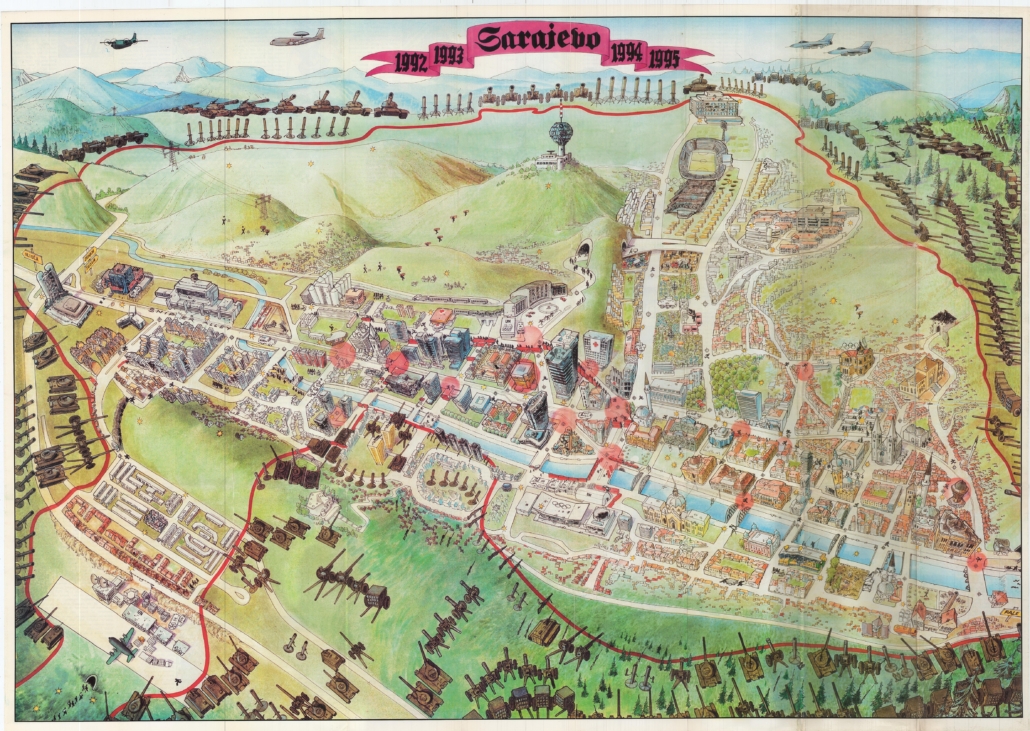
A survival map provided by FAMA International that documented the Siege of Sarajevo and the disintegration of Yugoslavia.
A survival map provided by FAMA International that documented the Siege of Sarajevo and the disintegration of Yugoslavia [From David Rumsey Historical Map Collection]

Markale Market massacres
On 5 February 1994, the Army of Republika Srpska (VRS) fired a 120mm mortal shell into the Markale marketplace in Sarajevo, killing 68 people and injuring almost 200. On the same day, the Bosnian Serb leadership blamed ‘authorities in Sarajevo’ of planting explosives to influence the international community to blame the Serbs for the atrocities. A UNPROFOR report revealed that about 40 projectiles were fired from Serbian positions around Sarajevo on that day.

On 28 August 1995, five mortar shells hit the Markele market, killing 43 and injuring at least 70. A 1999 report to the UN concluded that the VRS was responsible for the second attack as well.

Conclusion
In December 1995, the Dayton Agreement was signed, ending the Bosnian War. On 29 February 1996, the Bosnian government declared the end of the siege.
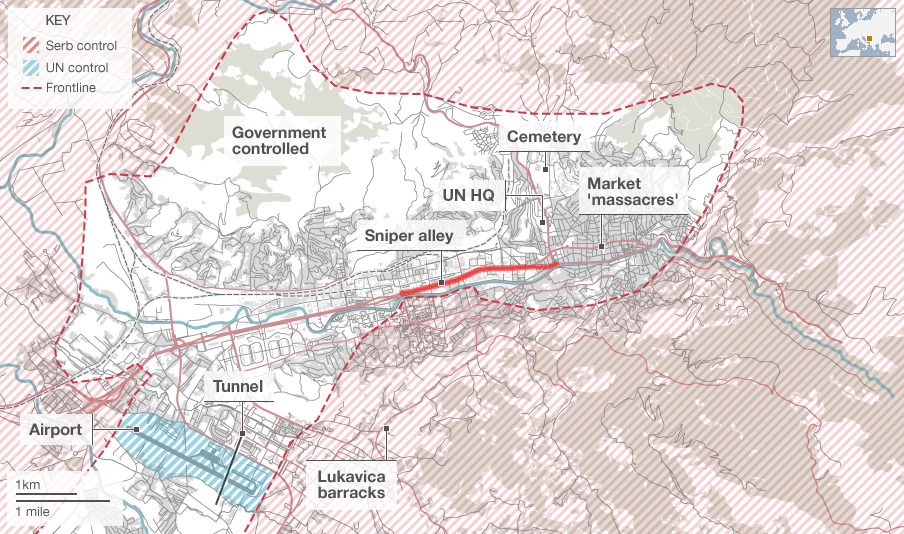
A map that illustrates the front lies around Sarajevo, highlighting areas controlled by the United Nations as well as the Serbs. [Map by BBC]

Join our JC History Tuition to learn more about the Bosnian War under the theme of Conflict and Cooperation. The H2 and H1 History Tuition feature online discussion and writing practices to enhance your knowledge application skills. Get useful study notes and clarify your doubts on the subject with the tutor. You can also follow our Telegram Channel to get useful updates.

We have other JC tuition classes, such as JC General Paper Tuition. For Secondary Tuition, we provide Secondary English Tuition, Secondary Math tuition, Secondary Chemistry Tuition, Social Studies Tuition, Geography, History Tuition and Secondary Economics Tuition. For Primary Tuition, we have Primary English, Math and Science Tuition. Call 8929 2422 to find out more.
How did Philippines grow its economy?

About the Philippine economy
After the attainment of independence, the Philippines became one of the leading Southeast Asian economies that was comparable to neighbouring countries, like Malaysia and Singapore. The 1970s became the turning point due to internal economic mismanagement, thus contributing to political turmoil that ended with a switch to the new administration by the early 1990s.

Topic of Study [For H2 History Students]:
Paper 2: Economic Development after Independence
Section B: Essay Writing
Theme II Chapter 1: Paths to Economic Development

1946 to 1965: Post-independent Philippines
During the early stages of independence, Philippines was heavily reliant on primary exports, due to its trade links with USA. This can be explained by the pre-indpendence policies, like the Payne Aldrich Tariff Act (1909) that granted US access to some Philippine goods.

One significant approach involved economic indigenization via the establishment of the National Development Company, which facilitated the formation of state agencies to control key sectors of the economy. For example, the Philippine Sugar Institute was formed in 1951.

The second strategy involved agricultural development. Given the heavy reliance on primary exports for growth, the government engaged in major land reforms, as seen by the Rice Share Tenancy Act (1946). The purpose was for resource consolidation and re-distribution.

1965 to 1986: The ‘era of Marcos’
Under the leadership of Ferdinand Marcos, the government continued its extensive state intervention to guide the development of the Philippine economy.

The government undergone transition for import-substitution industrialization (ISI) to export-oriented industrialization (EOI), as exemplified by policies that encouraged the inflow of foreign investment. For example, the Board of Investment was formed. This public entity then implemented the Investment Incentives Act (1967) to facilitate the influx of foreign investment. Additionally, the Export Incentives Act (1970) was introduced to provide incentives for the production of manufactured exports.

Following the imposition of martial law in 1972, the government raised its level of intervention in the economy. There was greater state ownership in various sectors, as seen by organizations like the Philippine Sugar Commission and the Asia Brewery.

Around the 1960s to 1970s, Marcos also capitalized on the Green Revolution to enhance the productivity of agriculture. The International Rice Research Institute (IRRI) was set up to allow the development of high-yielding and disease-resistant rice varieties. In addition, the ‘Masagana 99’ (Rice Production Programme) was introduced to grant rice farmers access to fertilizer subsidies and credit. Hence, the farmers benefited from state support, as seen by the achievement of self-sufficiency in rice production by 1972.

1986 to 1997: Post-Marcos Era
Following the economic instability and political unrest that caused the transition to a new administration, the Philippine government sought to resolve these past setbacks urgently.

One such obstacle was the large external debt due to Marco’s extensive borrowing. Austerity measures were introduced to reduce deficits. Also, the Comprehensive Agrarian Reform Law was passed in 1988 to facilitate land reforms, thereby transferring ownership to farmers.

Besides, there was greater privatization to reduce excessive state ownership, which was recognized as an inefficient approach for economic development. For example, monopolies in industries like telecommunications and power generation were dismantled.

Over time, the post-Marco period was met with greater success due to the restoration of economic stability. Privatization was effective in providing the country with its much-needed revenue for recovery. Gross Domestic Product (GDP) growth rate in the 1990s averaged at 3.3%.

What can we learn from this case study?
Consider the following question to understand this country-specific case study:
– To what extent was state involvement beneficial to the economic development of the Philippines after independence? [to be discussed in class]

Now that you have examined the strategies and outcomes of the Philippine economy, we encourage you to attempt essay questions to review your knowledge thoroughly. An alternative approach is to join our JC History Tuition. We provide useful summary notes and essay outlines to enhance your knowledge application skills.

The H2 and H1 History Tuition feature online discussion and writing practices to enhance your knowledge application skills. Get useful study notes and clarify your doubts on the subject with the tutor. You can also follow our Telegram Channel to get useful updates.

We have other JC tuition classes, such as JC Math Tuition and JC Chemistry Tuition. For Secondary Tuition, we provide Secondary English Tuition, Secondary Math tuition, Secondary Chemistry Tuition, Social Studies Tuition, Geography, History Tuition and Secondary Economics Tuition. For Primary Tuition, we have Primary English, Math and Science Tuition. Call 9658 5789 to find out more.

How to write an A Level History essay?

How to write a History Essay? In general, essay writing involves the organization of arguments to support or challenge a given view in the question statement. In the context of A Level History essay writing, it is important to adopt an argumentative style of writing to convince your reader that your stand is sound and well-analyzed. However, it is insufficient to weave a continuous line of arguments and submit your script with the expectation that you have just aced the examination. In this article, we will examine some key considerations that will support your efforts to create a good essay.

1: Read the question carefully The first step to do well for A Level History essay is to read the question. Some students are eager to skip the reading process and attempt the writing immediately, which can lead to fatal errors. It is imperative that you read the question and pick out the keywords. Pay attention to the command words, like “assess”. Also, identify the given view in the question statement to find out what is the opposing view, in order to take a clear stand in your introduction. During our JC History Tuition, we conduct class discussions to guide students through the reading process, by using example essay questions. Through proper reading and annotation setting, you will realise the importance of careful reading, such as the identification of possible arguments to support your essay writing.

2: Set your essay outline Once you have analyzed the essay question, plan your essay outline. By deriving a rough guideline on how you can arrange your ideas in the essay, this approach minimizes the potential error in which you arrive at a stumbling block and you are unable to decide on the direction of your subsequent paragraphs. The outline should be written in five minutes or less. Focus your efforts on the listing of key arguments that support your stand and those that challenge it. Under each argument, you can list down examples that come to your mind. Now, you are ready to write.

3: Acknowledge the given view in the question Similar to how individuals engage in intellectual debates, it is important that you acknowledge the view stated in the question. Failure to do so, you may risk being marked down for the ‘inability to answer the question’. To do this, you should explain how the given view answers the question.

Example Question: “The effectiveness of the United Nations (UN) peacekeeping efforts depended solely on the Security Council.” How far do you agree with this view in the period of 1945 to 1991?

With reference to the above example question, you should acknowledge and explain the given view of how the Security Council played a part in contributing to the successes of the United Nation peacekeeping efforts in the first paragraph of your ‘Main Body’.

4: Align the arguments to your stand This alignment of argument depends on the direction stated in your stand (which should be stated in your ‘Introduction’. With reference to the above question, if your stand is that you disagree and argue that the effectiveness of the UN did not depend on the Security Council, but rather the General Assembly, then your second paragraph should provide an analysis of the limitations of the Security Council’s role.

Bear in mind that the analysis of factors in every essay question cannot be memorised and stored piecewise in your own revision notes. It is a misleading approach that limits your thinking ability. Instead, our JC History Tuition will feature numerous question practices to widen the scope of assessments, such that you will be familiar with the possible perspectives in a given topic.

What’s Next? Practice makes perfect! I strongly encourage you to attempt more essays. Once you start, you will realise that this perceived sense of hesitation and reluctance can be overcome. Furthermore, your worries (Can I complete my essays on time? How do I remember so many examples?) will dissipate as you practice more often. I do not deny that writing can be a frictional process at the start. Do not give up. Your determination will bring you closer to your goal.

The H2 and H1 History Tuition feature online discussion and writing practices to enhance your knowledge application skills. Get useful study notes and clarify your doubts on the subject with the tutor. You can also follow our Telegram Channel to get useful updates.

We have other JC tuition classes, such as JC Math Tuition and JC Chemistry Tuition. For Secondary Tuition, we provide Secondary English Tuition, Secondary Math tuition, Secondary Chemistry Tuition, Social Studies Tuition, Geography, History Tuition and Secondary Economics Tuition. For Primary Tuition, we have Primary English, Math and Science Tuition. Call 9658 5789 to find out more.