
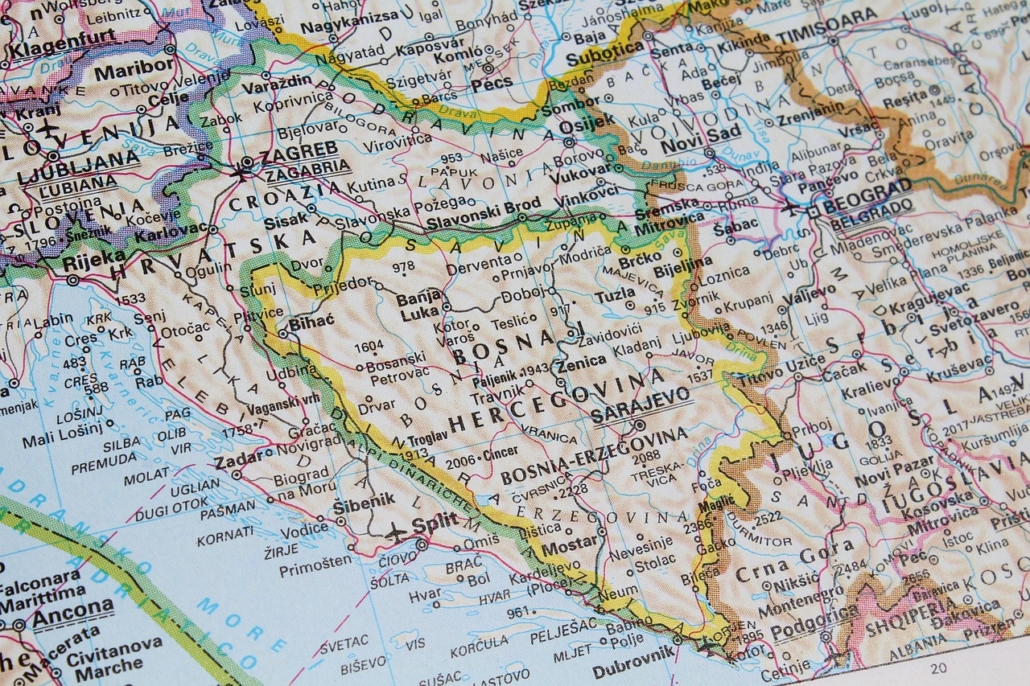
What Happened in the Siege of Sarajevo?
Topic of Study [For H2 History 9174 Students]:
Paper 1: Conflict and Cooperation (1945-2000)
Section B: Essay Writing
Theme III Chapter 4: Intra-State Conflicts [Bosnian War, 1992-1995]
Historical context: The Liberalisation of BiH
In February 1992, a ‘Referendum Weekend’ was scheduled as a requirement to recognise the independence of Bosnia and Herzegovina (BiH). While the Bosniaks and Croats supported the referendum, the Serbian Democratic Party (SDS) – led by Radovan Karadžić – boycotted said referendum. The SDS rallied the Bosnian Serbs to support its stance.
The SDS was against the referendum because it feared that independence of BiH would turn the Bosnian Serbs into a minority, violating their interests to remain part of Yugoslavia.
Of the three (communities), Bosniacs were the strongest proponents of a sovereign unitary state. While open to Bosnian sovereignty, Croats preferred cantonization. For their part, Serbs preferred for BiH to remain within the FRY; their second-best option revolved around the right of Serb areas to seek secession and rejoin the FRY. Not only did the three communities broadly disagree, Serbs considered the birth of independent BiH illegal because of the fact that the referendum on independence had gone ahead in spite of the boycott of one of the constituent people.
An excerpt taken from “When the Total is less than the Sum of the Parts: The Lessons of Bosnia and Herzegovina” by Marie-Joëlle Zaha.
Eventually, BiH declared independence from the Socialist Federal Republic of Yugoslavia (FRY) on 1 March 1992. On that same day, a shooting incident occurred.
The Baščaršija shooting incident
During a Bosnian Serb wedding procession in the Baščaršija district of Sarajevo, a Bosnian paramilitary member, Ramiz Delalic, killed the groom’s father and wounded an Orthodox priest. The attack sparked tensions over the display of Serbian national symbols during the wedding.
The Bosnian Serb community was outraged by the shooting, viewing the attack as a deliberate act of ethnic violence, giving rise to mobilisation and the setting up of barricades across Sarajevo. This incident highlighted the emergence of inter-ethnic violence.
According to a report by the CSCE, the blockade of the city ‘turned from spontaneous protests provoked by the wedding incident to an SDS-controlled effort’. Thus the barricades appeared not simply to ‘protect Serbs’ in the wake of the Baščaršija shooting but to demonstrate that the SDS would not accept lightly a declaration of independence in the event of a ‘yes’ vote.
An excerpt taken from “Reporting the Siege of Sarajevo” by Kenneth Morrison and Paul Lowe (2021).
The Siege
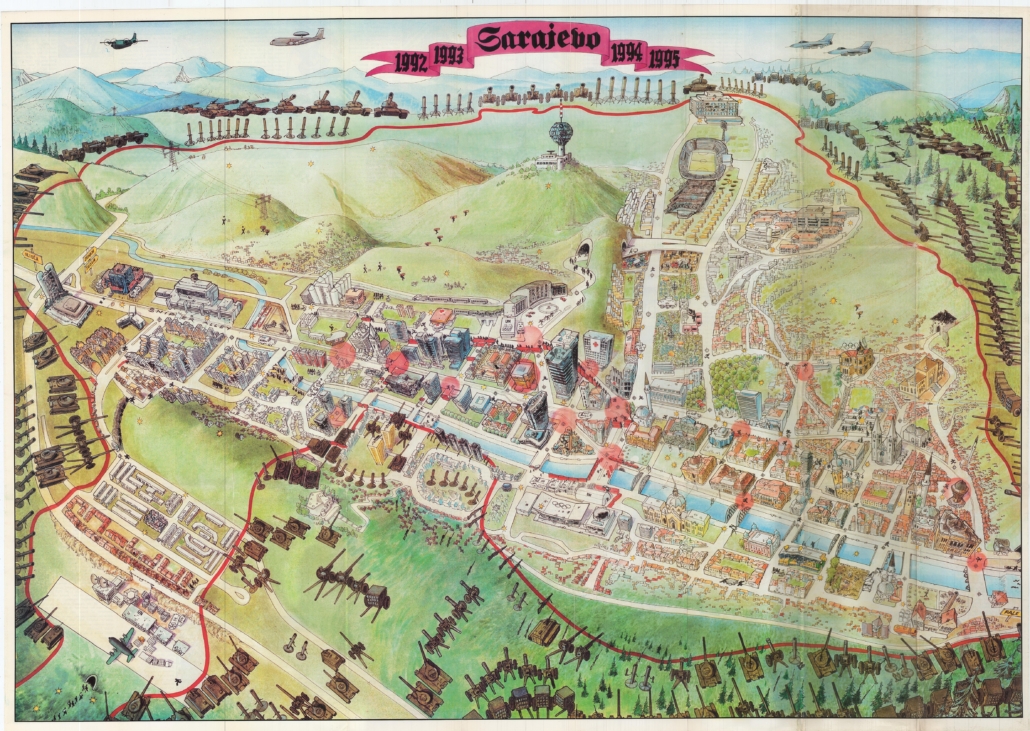
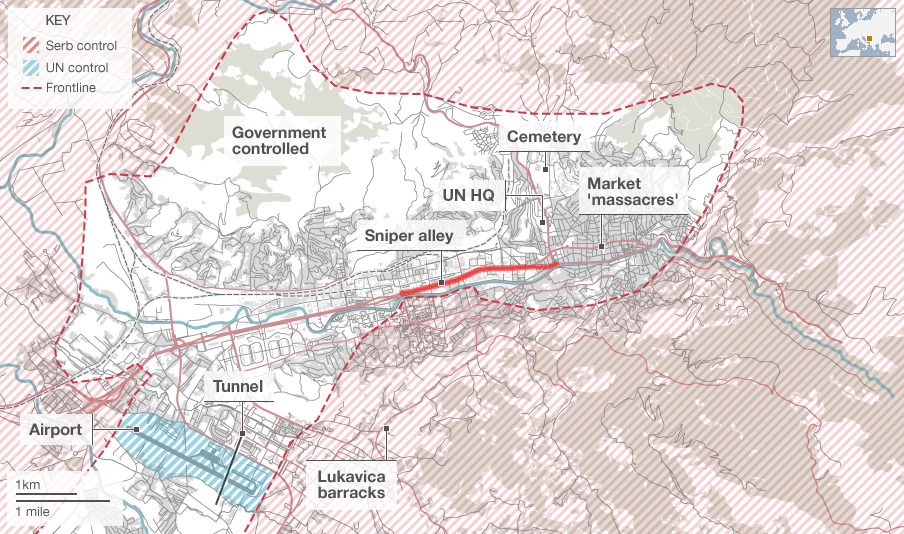
Bosnian Serb forces seized the capital city of Sarajevo, starting a four year-long brutal campaign that terrorised the citizens within. Sarajevo was under siege on 5 April 1992, trapping inside the city.
From May 1992 onwards, Serb forces attacked civilian areas of the city, resorting to shelling and sniping to wreck havoc on the population. Consequently, casualties mount. Between 1992 and 1995, more than 13,000 people had died, including 5,000 civilians. Much of the infrastructure in Sarajevo was damaged or destroyed, including religious buildings.
In early 1993, the Serb forces attacked the Cerska area in eastern BiH, forcing thousands of Bosniaks to flee to UN-declared ‘Safe Areas’.
Markale Market massacres
On 5 February 1994, the Army of Republika Srpska (VRS) fired a 120mm mortal shell into the Markale marketplace in Sarajevo, killing 68 people and injuring almost 200. On the same day, the Bosnian Serb leadership blamed ‘authorities in Sarajevo’ of planting explosives to influence the international community to blame the Serbs for the atrocities. A UNPROFOR report revealed that about 40 projectiles were fired from Serbian positions around Sarajevo on that day.
On 28 August 1995, five mortar shells hit the Markele market, killing 43 and injuring at least 70. A 1999 report to the UN concluded that the VRS was responsible for the second attack as well.
Conclusion
In December 1995, the Dayton Agreement was signed, ending the Bosnian War. On 29 February 1996, the Bosnian government declared the end of the siege.
Join our JC History Tuition to learn more about the Bosnian War under the theme of Conflict and Cooperation. The H2 and H1 History Tuition feature online discussion and writing practices to enhance your knowledge application skills. Get useful study notes and clarify your doubts on the subject with the tutor. You can also follow our Telegram Channel to get useful updates.
We have other JC tuition classes, such as JC General Paper Tuition. For Secondary Tuition, we provide Secondary English Tuition, Secondary Math tuition, Secondary Chemistry Tuition, Social Studies Tuition, Geography, History Tuition and Secondary Economics Tuition. For Primary Tuition, we have Primary English, Math and Science Tuition. Call 8929 2422 to find out more.

 Pixabay