What happened in South West Africa?

Topic of Study [For H1/H2 History Students]:
Paper 1: Safeguarding International Peace and Security 
Section B: Essay Writing
Theme III Chapter 2: International Court of Justice: ensuring adherence to international law; arbitration and advisory opinion

Historical Background: Mandate Territory and Trust Territory
After the end of World War One, the German colony South West Africa was declared a League of Nations (LON) Mandate Territory. Under the Treaty of Versailles, South West Africa was considered a British protectorate with the Union of South Africa handling its administration. When World War Two came to an end, the LON Mandates were moved to the United Nations (UN) Trusteeship system, thus South West Africa was expected to become a UN Trust Territory.

However, the South African government opposed the process of South West Africa becoming a UN Trust Territory. Its Prime Minister Field Marshal Jan Christian Smuts supported policies of racial segregation in South Africa, sparking controversy among member nations in the UN General Assembly (UNGA).

First key response by the Court
On 11 July 1950, the International Court of Justice (ICJ) gave its Advisory Opinion at the request of the UNGA. With regards to the legal status of the territory in South West Africa, the ICJ asserted that the UN was “legally qualified to discharge the supervisory functions formerly exercised by the League of Nations”. Also, South Africa “had no competence to modify the international status of South West Africa unilaterally”.

If the reason for the South African government’s refusal to cooperate or negotiate with the United Nations about the status and administration of South West Africa was the fear that its racial policy would be discussed in the world forum, its tactics were a complete failure. On December 6, 1955, the General Assembly adopted a resolution which emphasized racial policy in the territory as the chief issue. It reminded the Union government “of the faith it had re-affirmed in signing the Charter, in fundamental human rights and in the dignity and worth of the human person,” and called on it to observe Article 56 of the Charter.

An excerpt taken from “South Africa and the World: The Foreign Policy of Apartheid” by Amry Vandenbosch.

Even so, South Africa did not relent with its repressive policies towards South West Africa. With mounting pressure from the member states in the Sub-Saharan region in the UNGA, the UN Security Council (UNSC) passed resolutions in 1969 and 1970, denouncing South Africa’s occupation of South West Africa.

On 12 June 1968, under UNGA Resolution 2372 (XXII), South West Africa was renamed as Namibia.

The second key response by the Court
On 29 July 1970, the UNSC requested the ICJ to give an Advisory Opinion on the legal consequences for states of the continued presence of South Africa Namibia. On 21 June 1971, the Court declared that South Africa’s presence in Namibia was illegal, thus the former should withdraw its administration. At the same time, the Court stated that all member states of the UN had to recognise the “illegality of South Africa’s presence in Namibia and the invalidity of its acts on behalf of or concerning Namibia”.

In the Namibia Opinion, the ICJ drew another set of limits, this time in the context of treaty law, to the responses that states may legitimately adopt, even where this concerned an obligation erga omnes (towards all), the breach of which was invoked by, and the reaction to the breach authorized by, collective bodies. The ICJ held that the obligations of states flowing from a Security Council resolution (in this case, Resolution 276 (1970)) not to enter into treaty relations with South Africa could not “be applied to certain general conventions such as those of a humanitarian character, the non-performance of which may adversely affect the people of Namibia”, a holding reminiscent of Article 60(5) of the 1969 Vienna Convention.

An excerpt taken from “The International Court of Justice: Its Future Role After Fifty Years” by J. M. Thurnszky Sam Muller and A. S. Muller.

This time, the UNSC passed Resolution 418, imposed a mandatory arms embargo against South Africa to put sufficient pressure on the latter to comply with the Court’s Opinion. On 22 December 1988, the Tripartite Accord was signed by Angola, Cuba and South Africa, granting independence to Namibia from South Africa.

What can we learn from this article?
Consider the following question:
– Assess the view that the International Court of Justice was effective in managing the legal dispute over South West Africa.


Join our JC History Tuition to learn more about the United Nations. The H2 and H1 History Tuition feature online discussion and writing practices to enhance your knowledge application skills. Get useful study notes and clarify your doubts on the subject with the tutor. You can also follow our Telegram Channel to get useful updates.

We have other JC tuition classes, such as JC Math Tuition and JC Chemistry Tuition. For Secondary Tuition, we provide Secondary English Tuition, Secondary Math tuition, Secondary Chemistry Tuition, Social Studies Tuition, Geography, History Tuition and Secondary Economics Tuition. For Primary Tuition, we have Primary English, Math and Science Tuition. Call 9658 5789 to find out more.
How did the UN respond to the Suez Canal crisis?

Topic of Study [For H1/H2 History Students]:
Paper 1: Safeguarding International Peace and Security 
Section B: Essay Writing
Theme III Chapter 2: Political Effectiveness of the UN in maintaining international peace and security

Historical Context: Trouble in Suez
In October 1956, Egypt, Jordan and Syria formed a joint military command that alarmed Israel. When the USA and UK backed down on their decision to finance the development of an Aswan dam project for Egypt, President Nasser nationalised the Suez Canal, declaring that the transit fees would be used to pay for the infrastructure.

In retaliation, Britain and France orchestrated an attack on Egypt to reclaim the Suez. In the process, Israel was brought into the picture. On 29 October 1956, Israel invaded Sinai. On 5 November, the British and French deployed paratroopers along the Suez Canal. From October 1956 to March 1957, the Suez Canal was closed as a result of the crisis.

The [Suez] canal had been built during the 1860s under French management in partnership with Egypt. The canal itself was Egyptian, guaranteed as an open waterway under an international treaty, the Convention of Constantinople, signed in 1888. But the canal was operated by an unusual private firm, the Universal Suez Canal Company, headquartered in Paris. The British had bought a large minority of the stock from a bankrupt Egyptian government in 1875. The company had a concession to operate the canal until 1968. Surrounding the canal, loaded with infrastructure such as railroads, harbors, and warehouses, was the Canal Zone – an elaborate British base operated under an Anglo-Egyptian treaty signed in 1936.

An excerpt taken from “Suez Deconstructed: An Interactive Study in Crisis, War, and Peacemaking” by Philip Zelikow and Ernest May.

The First United Nations Emergency Force: UNEF I
On 7 November 1956, the United Nations General Assembly passed resolution 1001, leading to the creation of a peacekeeping force, known as the First United Nations Emergency Force (UNEF I). UNEF I was tasked to secure and supervise the cessation of hostilities, including the withdrawal of foreign troops (France, Britain and Israel) from Egyptian territory. Also, the UNEF I functioned as a buffer between Egyptian and Israeli forces, monitoring a ceasefire agreement that lasted for ten years.

Through the efforts of Canada’s Minister for External Affairs Lester Pearson and various European delegates, on February 2 the General Assembly passed two resolutions that focused on both Egypt and Israel. The first deplored Israeli noncompliance with the earlier General Assembly resolution that had mandated a complete Israeli withdrawal from all occupied territory and called upon Israel to complete its pullback without delay. The second resolution called upon both countries to observe the armistice agreement and, after Israeli troops withdrew, mandated the stationing of UNEF troops on the Israeli-Egyptian border.

An excerpt taken from “The Economic Diplomacy of the Suez Crisis” by Diane B. Kunz.

With the help of the charismatic Secretary-General Dag Hammarskjöld, Nasser agreed to the presence of UNEF I on the condition that Egypt could revoke its agreement at any time. Furthermore, the peacekeeping troops stationed in Egypt have no authority over the people. On the other hand, Israel refused to give UNEF consent to enter its territory.

By February 1957, UNEF I had 6073 personnel, which were contributed by eleven member states of the United Nations (Yugoslavia, Finland, India, Indonesia, Norway, Sweden, Canada, Brazil, Colombia, Denmark and Norway).

Six-Day War: A political bystander?
However, Egypt no longer welcomed UNEF’s presence by 1967. Given Israel’s participation in the invasion of Egypt during the Suez Canal Crisis as well as its hostility following the Palestinian War of 1948, tensions were high.

In May 1967, the Soviet Union delivered reports to Egypt, claiming that Israeli troops were amassing on the Syrian border. In anticipation of a possible military incursion, Nasser withdrew consent, forcing Secretary-General U Thant to comply with the expulsion of UNEF stationed in the Sinai Peninsula.

On 13 May 1967, [Nasser] received a Soviet intelligence report claiming that Israel was massing troops on Syria’s border. Nasser responded by taking three successive steps that made war virtually inevitable: he deployed his troops in the Sinai close to Israel’s border, he expelled the UN Emergency Force (UNEF) from the Sinai, and, on 22 May, he closed the Straits of Tiran to Israeli shipping. In Israeli eyes, this was a casus belli, a cause for war. On 5 June, Israel seized the initiative and launched the short, sharp war that ended in a resounding military defeat for Egypt, Syria, and Jordan.

An excerpt taken from “The 1967 Arab-Israeli War: Origins and Consequences” by Avi Shlaim and William Roger Louis.

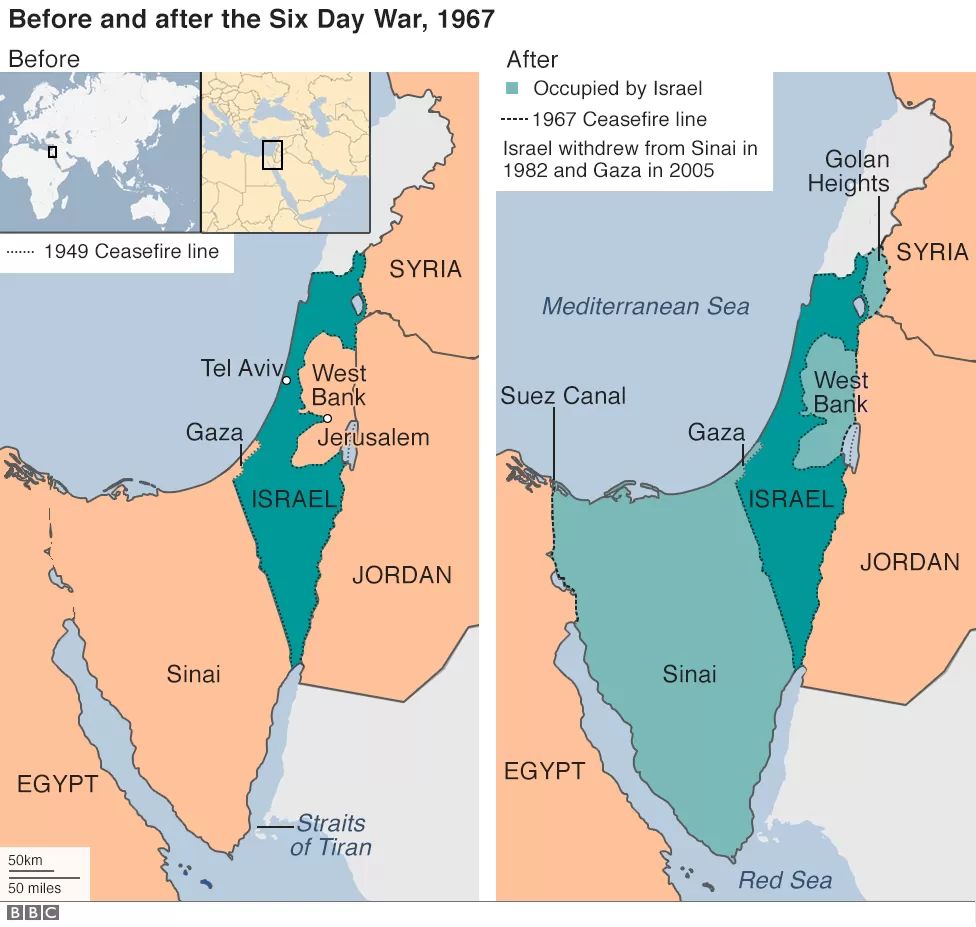
Egypt then declared its intention to impose a blockade through the Straits of Tiran, which would have hampered Israel’s access to the Red Sea. Israel was outraged by this announcement, declaring the blockade as an act of war. On 5 June 1967, Israel commenced Operation Focus, which was a series of pre-emptive air strikes that disabled Egyptian air operations. This marked the start of the Six-Day War.

Evidently, the UN peacekeepers were helpless to the situation in spite of their initial success in response to the Suez Crisis.

An illustration on the changes to Israeli-controlled territories before and after the Six Day War of 1967. [Source: BBC]

What can we learn from this article?
Consider the following question:
– How far do you agree that the key factor that determined the successes of United Nations peacekeeping was the cooperation of member states?


Join our JC History Tuition to learn more about the United Nations. The H2 and H1 History Tuition feature online discussion and writing practices to enhance your knowledge application skills. Get useful study notes and clarify your doubts on the subject with the tutor. You can also follow our Telegram Channel to get useful updates.

We have other JC tuition classes, such as JC Math Tuition and JC Chemistry Tuition. For Secondary Tuition, we provide Secondary English Tuition, Secondary Math tuition, Secondary Chemistry Tuition, Social Studies Tuition, Geography, History Tuition and Secondary Economics Tuition. For Primary Tuition, we have Primary English, Math and Science Tuition. Call 9658 5789 to find out more.
How did decolonisation affect the United Nations?

Topic of Study [For H1/H2 History Students]:
Paper 1: Safeguarding International Peace and Security 
Section B: Essay Writing
Theme III Chapter 2: Political Effectiveness of the UN in maintaining international peace and security

Historical context
On 14 December 1960, the United Nations General Assembly adopted the “Declaration on the Granting of Independence to Colonial Countries and Peoples”. In essence, the Declaration advocated the right to self-determination, thereby bringing an end to colonial rule.

Recognizing that the peoples of the world ardently desire the end of colonialism in all its manifestations, […]

2. All peoples have the right to self-determination; by virtue of that right they freely determine their political status and freely pursue their economic, social and cultural development.

An excerpt taken from the United Nations General Assembly Resolution 1514 (XV), 947th plenary meeting, 14 December 1960.

A commitment to decolonisation: C-24
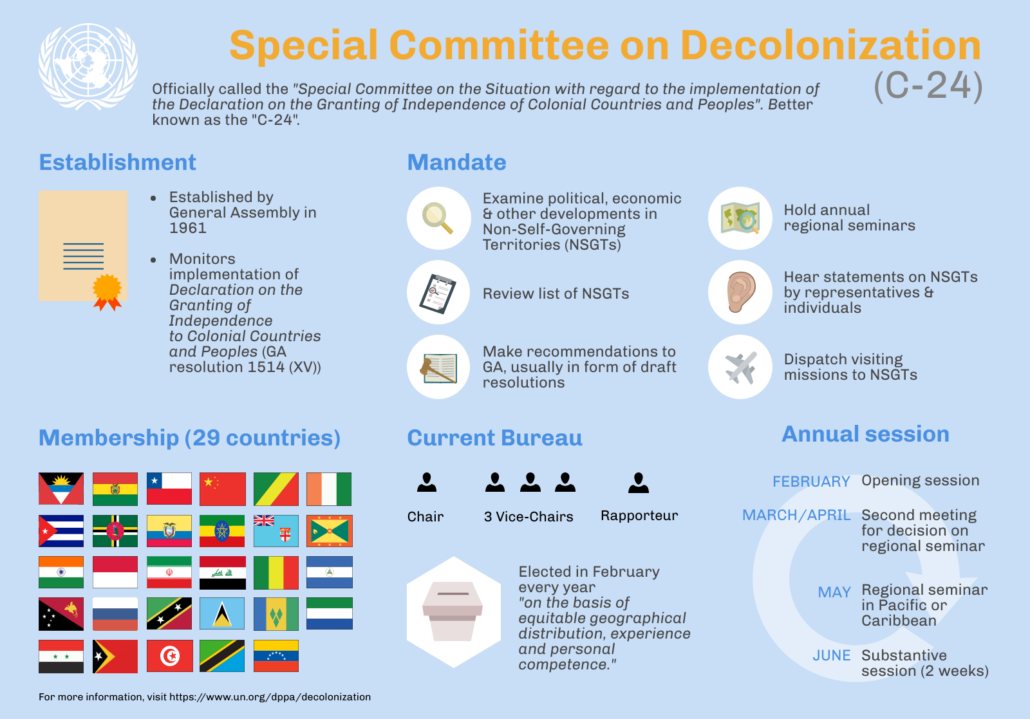
To oversee the decolonisation process, a Special Committee was established in 1961 in accordance to the General Assembly resolution 1654 (XVI). The Committee of Twenty-four, also known as C-24, carries out activities, such as examining the political and economic developments of non-self-governing territories (NSGTs).


Infographic on the Special Committee on Decolonization. [Source: United Nations]

By resolution 1603 (XV) of 20 April 1961, a Sub-Committee on the Situation in Angola was created. Angola was both a colonial issue involving a commencement case, as well as a complex political situation characterized by armed conflict. In 1962 this Sub-Committee was absorbed by what was becoming the main U.N. instrumentality for decolonization, namely the Special Committee of Twenty-Four.

With a view to centralizing the U.N. action in the area of decolonization, and to concentrate it in the hands of the Special Committee of Twenty-Four, the pattern of absorption was repeated with regard to the Committee on South West Africa which was dissolved in 1961.

An excerpt taken from “The United Nations and Decolonization: The Role of Afro-Asia” byy Yassin El-Ayouty.

Branching out to security matters
In the early 1960s, the newly-formed C-24 tried to garner support from the United Nations Security Council. It called on the Council to address the issue in South West Africa, citing security concerns. Likewise, a similar matter was raised in Southern Rhodesia two years later. In 1965, the Committee expressed concerns in the Aden territory, labelling it as a ‘dangerous situation’.

Yet, the Security Council’s responses were not identical. For instance, the Council recognised the threats in South West Africa, but not so in Aden.

It is doubtful if in practice the Committee of Twenty-four had much influence on the policies which the colonial powers pursued in the territories for which they were responsible. Its pronouncements were for them an extremely marginal factor among all the considerations which had to be taken into account (including often a nationalistic home opinion holding diametrically opposite views). They were a factor which, if considered at all, were more important in the eyes of their foreign offices than of their colonial departments which had the main responsibility for policy concerning their colonial territories.

An excerpt taken from “A History of the United Nations: Volume 2: The Age of Decolonization, 1955–1965” by Evan Luard.

What can we learn from this article?
Consider the following question:
– How far do you agree that decolonisation created problems for the United Nations General Assembly?


Join our JC History Tuition to learn more about the United Nations. The H2 and H1 History Tuition feature online discussion and writing practices to enhance your knowledge application skills. Get useful study notes and clarify your doubts on the subject with the tutor. You can also follow our Telegram Channel to get useful updates.

We have other JC tuition classes, such as JC Math Tuition and JC Chemistry Tuition. For Secondary Tuition, we provide Secondary English Tuition, Secondary Math tuition, Secondary Chemistry Tuition, Social Studies Tuition, Geography, History Tuition and Secondary Economics Tuition. For Primary Tuition, we have Primary English, Math and Science Tuition. Call 9658 5789 to find out more.
Why did Nixon end the Bretton Woods system?

Topic of Study [For H2 History Students]: 
Paper 1: Understanding the Global Economy (1945-2000)
Section B: Essay Writing
Theme II Chapter 1: Problems of economic liberalisation

Historical background
In 1944, an international monetary agreement was signed in 1944 at the Bretton Woods Conference. Under this agreement, foreign currencies were defined in terms of the US dollar (USD). A new system was established in the post-WWII period to replace the Gold Standard that ended in 1993 following the Great Depression.

Under this system, a fixed exchange rate was established, in which one ounce of gold is equivalent to 35 USD.

When nations participate in a pegged exchange-rate system, they agree to fix the value of their currencies relative to another currency rather than to a commodity such as gold. The US dollar was chosen as the base currency and all the countries agreed to keep the value of their currency within plus or minus 1 percent of a specific value of the dollar. […] In contrast to all other nations, the US currency maintained a relationship with gold fixed at $35/ounce. Thus, because the US dollar remained fixed to gold, this was an indirect gold standard, but nations used US dollars rather than gold to settle international transactions.

An excerpt taken from “International Business: Strategy and the Multinational Company” by K. Praveen Parboteeah and John B. Cullen.

With support from the International Monetary Fund (IMF), an automatic adjustment helped nations to avoid the onset of deflation, thereby maintaining stable exchange rates. By the late 1950s, key trading nations loosened exchange restrictions to accept the international gold standard.

Dollar shortage & the Gold Pool
Following the Second World War, governments in Western Europe imported US-made machinery and merchandise. Consequently, there was a surge in demand for USD, given that more nations underwent post-war economic reconstruction. During the Presidential polls in August 1960, US Senator John F. Kennedy declared his plan to “get America moving again“, giving rise to a ‘gold rush’.

As a result, the increase in market price of gold in London to $40 sparked fears of an unstable USD-gold parity. As such, a “Gold Pool” was created in November 1961, in which eight central banks agreed to buy and sell gold only at the official price of $35. Seven other central banks agreed to provide half of the gold supply to keep the market price of gold stable.

The spike in the London market price sparked fears that governments, seeing the writing on the wall, might demand wholesale conversion of their dollars into gold. In response, the US Treasury provided the Bank of England with gold to be used to bring the price of gold on the London gold market, where the metal was bought and sold by private investors (some would say “speculators”), back down to $35, and the governments of principal industrial countries agreed to refrain from buying gold at a higher price.

[…] What the left hand gave, the right hand taketh away, in other words, in a classic instance of a collective-action problem. As a result, the Gold Pool did little to resolve the internal contradictions of what was now referred to as the Bretton Woods gold-dollar system.

An excerpt taken from “The Bretton Woods Agreements: Together with Scholarly Commentaries and Essential Historical Documents” by Naomi Lamoreaux and Ian Shapiro.

Overvaluation of the USD: A currency crisis and a gold glut
However, the USA faced problems with the system. In the early 1960s, the USA experienced rising inflation. As a result of inflation, the increase in silver prices made it difficult for the USA to ensure adequate circulation of coins and silver certificates. In response, the Congress repealed the Silver Purchase Act in 1963 and enabled the Federal Reserve to produce notes in $1 and $2 denominations. At the same time, silver certificates were gradually retired, thus freeing up the silver holdings for use as coins.

Yet, inflation persisted. In 1968, the Congress repealed the requirement to hold gold reserves against Federal Reserve notes. This led to the collapse of the “Gold Pool”.

By the late 1960s, the inflationary condition exacerbated by the large spending to finance the ‘Great Society’ and the Vietnam War strained the international monetary system. Although a two-tier gold market was created in March 1968, foreign governments viewed it with much skepticism. Central banks were unwilling to accept USD in settlement.

The Bretton Woods was based on gold, but the global gold stock could not meet the world’s demand for international reserves, without which pegged exchange rates were impossible. Consequently, the United States provided dollar reserves by running a persistent balance of payments deficit and promised to redeem those dollars for gold at $35 per ounce. By 1961, however, the amount of dollar claims outstanding began to exceed the US government’s stock of gold. The deficit of gold implied that the United States might not be able to keep its pledge to convert dollars for gold at the official price.

[…] The prospect of a dollar devaluation created strong incentives to exchange dollars for US gold. The US Treasury and the Federal Reserve tried to keep this from happening through stop-gap measures, but they could not solve the underlying paradox: Without additional dollar reserves, the system was unworkable; with additional dollar reserves, the system was unstable.

An excerpt taken from “Currency Stability and a Country’s Prosperity: “Does a Mandatory Currency Stability Law Determine the Stability and or Prosperity of a Country?” by John E. Baiden.

As a result, US President Richard Nixon ‘closed the gold window‘ in August 1971, thereby disallowing foreign central banks from exchanging USD for the US Treasury’s gold. Notably, Nixon blamed other countries for their reluctance to share the military burden of the Cold War, which in turn contributed to the persistent balance of payments deficit.

What can we learn from this article?
Consider the following question:
– How far do you agree that the problems of the Crisis Decades were the result of American economic policies?

Join our JC History Tuition to learn more about the Global Economy. The H2 and H1 History Tuition feature online discussion and writing practices to enhance your knowledge application skills. Get useful study notes and clarify your doubts on the subject with the tutor. You can also follow our Telegram Channel to get useful updates.

We have other JC tuition classes, such as JC Math Tuition and JC Chemistry Tuition. For Secondary Tuition, we provide Secondary English Tuition, Secondary Math tuition, Secondary Chemistry Tuition, Social Studies Tuition, Geography, History Tuition and Secondary Economics Tuition. For Primary Tuition, we have Primary English, Math and Science Tuition. 


Credit Featured Image: https://pixabay.com/photos/gold-bars-wealth-finance-gold-bars-163519/ (Free for use under Pixabay Content License)

How did the Gulf states dominate the global oil market?

Topic of Study [For H2 History Students]: 
Paper 1: Understanding the Global Economy (1945-2000)
Section B: Essay Writing
Theme II Chapter 1: Reasons for growth of the global economy; Chapter 2: Reasons for problems of the global economy 

The value of ‘Black Gold’: Oil
As the Allied powers concluded the Second World War (WWII) with the help of the USA, the latter recognised the strategic and economic value of oil, given its relevance to enable the continuation of war efforts then.

After the Yalta Conference, US President Franklin Roosevelt met the Saudi King Abdel Aziz on the cruiser USS Quincy on 14 February 1945. The Saudi King agreed to let the USA carry out port visits and build an airfield. At the same time, concession was given to the oil production by the Saudi-American Oil Company (Aramco). Notably, this collaborative relationship continued after WWII.

Since then, a special relationship between the two countries has evolved, due not only to mutual interest in reliable supplies of oil flowing to the West but also to their close cooperation in Middle East regional security. During the Cold War, Saudi Arabia considered atheistic Soviet Communist ideology to be the greatest threat to Muslim hearts and minds. Thus, the kingdom also opposed radical Arab leaders such as President Gamal Abdel Nasser of Egypt, who established cordial relations with the Soviet Union.

An excerpt taken from “Government and Politics of the Middle East and North Africa: Development, Democracy, and Dictatorship” by Mark Gasiorowski and Sean Yom.

During the Cold War, the USA rose to prominence by acting as a security guarantor for the six Arab states in the Persian Gulf (Bahrain, Oman, Qatar, Kuwait, Saudi Arabia and the United Arab Emirates). Having a reliable access to oil supply was vital in facilitating post-war economic reconstruction. As such, the USA was a key importer of oil, thereby keeping the Middle Eastern powers relevant.

US interest in the Gulf was also a by-product of the postwar economy in the developed world. Postwar reconstruction, a growing western consumer power, and the mass hydrocarbons at the centre of the world’s wealthier economies, and created an explosion in demand, with the unsurprising result that ensuring secure and reliable access to oil supplies became a central pillar of US and western foreign policies. […] From that time, the sheer size and quality of the Middle East’s reserves meant that the region could probably never have avoided becoming entangled in international politics as it did during and after the Cold War.

An excerpt taken from “The Economy of the Gulf States” by Matthew Gray.

Jockeying for position: Claiming ownership rights and petrodollars
Before the Organisation of Petroleum Exporting Countries (OPEC) was formed in 1960, the “Seven Sisters” dominated the global oil industry. In 1908, the British discovered oil in western Persia (which later came to be known as Iran). Six years later, the Anglo-Persian Oil Company (APOC) was formed, with the British holding 51% stake in it.

In the 1950s, in line with developments in the international oil business, companies were compelled to shift to 50:50 profit-sharing agreements. For the first time, oil revenues were truly substantial: the Bahraini ruler received oil revenues of about £2.5 million in the mid-1950s. In Kuwait, the 50:50 agreement of 1950 generated £60 million from the Al Sabah in the mid-1950s, while the Qatari rulers received about £5 million per year. The Saudi oil income reached about £20 million in 1950, but rose faster than that of any other country in the region.

An excerpt taken from “The Emergence of the Gulf States: Studies in Modern History” by John Peterson.

Initially, the OPEC was formed as a result of the Baghdad Conference of September 1960 to ensure stable oil prices in the markets. However, as its membership size grew (15 in the 1970s), the organisation began to challenge the “Seven Sisters”.

In 1968, the regional group similar to OPEC, known as the Organisation of Arab Petroleum Exporting Countries (OAPEC) was formed. Its rising dominance in the oil markets was made known when an oil embargo was imposed against the USA during the Yom Kippur War, thus triggering the Energy Crisis of the 1970s.

What can we learn from this article?
Consider the following question:
– How far do you agree that oil was the most important factor that shaped the global economy in the 20th century?

Join our JC History Tuition to learn more about the Global Economy. The H2 and H1 History Tuition feature online discussion and writing practices to enhance your knowledge application skills. Get useful study notes and clarify your doubts on the subject with the tutor. You can also follow our Telegram Channel to get useful updates.

We have other JC tuition classes, such as JC Math Tuition and JC Chemistry Tuition. For Secondary Tuition, we provide Secondary English Tuition, Secondary Math tuition, Secondary Chemistry Tuition, Social Studies Tuition, Geography, History Tuition and Secondary Economics Tuition. For Primary Tuition, we have Primary English, Math and Science Tuition. Call 9658 5789 to find out more.
What is the peacekeeping role of the United Nations?

Topic of Study [For H1/H2 History Students]:
Paper 1: Safeguarding International Peace and Security 
Section B: Essay Writing
Theme III Chapter 2: Political Effectiveness of the UN in maintaining international peace and security

Saving succeeding generations from the scourge of war: The United Nations
On 24 October 1945, an inter-governmental organisation known as the United Nations was established. Barely a month ago, the Second World War came to an end, giving many a stark reminder of the devastation and atrocities that warmongers can cause on others.

Five decades later, the Department of Peace Operations (DPO) was set up, streamlining processes to carry out peacekeeping missions to achieve myriad goals set and authorised by the United Nations Security Council (UNSC).

Defining peacekeeping: Origins
The first peacekeeping mission took place in 1948 when the UNSC authorised the deployment of military observers to the Middle East. In particular, the United Nations Truce Supervision Organisation (UNTSO) was established in May 1948 to monitor ceasefires, supervise armistice agreements and prevent conflicts from threatening the security of Middle Eastern nations.

In its first manifestations in the United Nations, and indeed earlier, in the inter-war years, peacekeeping was strictly an inter-state activity. It had to do with the management of stressed or fractured relations between sovereign states in the international system. The United Nations Emergency Force sent to Suez in 1956 (which is often misleadingly described as the first peacekeeping operation) was interposed between Egypt and the states that had attacked it (Britain, France and Israel) following its nationalization of the Suez Canal. After Suez the essential principles of peacekeeping employed there were seen to apply as well to previous UN undertakings that had not, at the time they were established, been given the name peacekeeping.

An excerpt taken from “Peacekeeping and the International System” by Norrie MacQueen.

Notably, peacekeeping became a more ‘organised’ activity for the United Nations in 1956 when its principles were defined by then United Nations Secretary-General Dag Hammarskjöld and Canadian minister Lester B. Pearson. Its principles were put to the test when the United Nations Emergency Force (UNEF) was deployed in response to the Suez Canal Crisis of 1956.

Ever since 1948, more than 70 peacekeeping missions have been undertaken by the United Nations, involving more than 120 countries that contributed hundreds of thousands of personnel. Notably, the UN Operation in the Congo (ONUC) was first large-scale mission that numbered 20,000 of military personnel.

Evolution of peacekeeping
In the post-Cold War phase, the role of United Nations peacekeepers was re-defined to keep the organisation relevant. Initially, the ‘blue helmets’ took on a ‘traditional’ role, which included tasks like monitoring ceasefires. In view of the rise of new challenges posed by intra-state conflicts, peacekeepers took up new responsibilities, like providing humanitarian assistance, monitoring human rights, as well as disarmament and demobilisation of former combatants.

As Secretary-General Kofi Annan memorably described the new UN role in 1998: “Our job is to intervene: to prevent conflict where we can, to put a stop to it when it has broken out, or – when neither of those things is possible – at least to contain it and prevent it from spreading.” He was reflecting the activism of the Security Council, which between 1987 and 1994 had quadrupled the number of resolutions it issued, tripled the peacekeeping operations it authorized, and multiplied by seven the number of economic sanctions it imposed per year. Military forces deployed in peacekeeping operations increased from fewer than 10,000 to more than 70,000.

An excerpt taken from “Making War and Building Peace: United Nations Peace Operations” by Michael W. Doyle and Nicholas Sambanis.

What can we learn from this article?
Consider the following question:
– Assess the view that United Nations peacekeeping was successful ever since its inception.

Join our JC History Tuition to learn more about the United Nations. The H2 and H1 History Tuition feature online discussion and writing practices to enhance your knowledge application skills. Get useful study notes and clarify your doubts on the subject with the tutor. You can also follow our Telegram Channel to get useful updates.

We have other JC tuition classes, such as JC Math Tuition and JC Chemistry Tuition. For Secondary Tuition, we provide Secondary English Tuition, Secondary Math tuition, Secondary Chemistry Tuition, Social Studies Tuition, Geography, History Tuition and Secondary Economics Tuition. For Primary Tuition, we have Primary English, Math and Science Tuition. Call 9658 5789 to find out more.
Why was NEDCOL created?

Topic of Study [For H2 History Students]:
Paper 2: Economic Development after Independence
Section B: Essay Writing
Theme II Chapter 1: Paths to Economic Development

Historical context: Rise of NEDCOL
After the end of World War Two, Prime Minister Plaek Phibunsongkhram led his government to oversee economic recovery. As a result of economic isolation, Thailand‘s rice trade declined significantly, with the exception of its continued trade efforts with imperial Japan during the war.

As part of its efforts to carry out import-substitution industrialisation (ISI), the Phibun government oversaw the creation of state agencies, such as the National Economic Development Corporation Limited (NEDCOL).

NEDCOL was established in 1954 as a holding company with five manufacturing subsidiaries, namely two sugar mills, a jute mill, marble factory and paper mill. NEDCOL functioned as a guarantor of loans, supporting the growth of Thai and Chinese businesses.

During the period 1947-57 development strategy, while never clearly stated, had all the characteristics of ISI. However, these policies did not centre on tariff protection. Tariffs were treated primarily as sources of revenue. In addition, Akrasanee and Juanjai have suggested that the Phibun regime ‘deliberately avoided protecting industries for fear of promoting the Chinese community’. Rather industrialisation was promoted through the direct participation of the state in production.

State enterprises were set up with monopolies in such areas as brewing, paper manufacture, sugar refining and gunny sack production. […] Through NEDCOL the state acted as a guarantor of loans enabling comparatively large-scale foreign funding to be obtained for many of these enterprises.

An excerpt taken from “South East Asia in the World-Economy” by Chris Dixon.

Notably, the government’s share of domestic investment from 32% in 1952 to more than 38% in the period 1953-55, highlighting the key role that direct state investment played in the manufacturing sector.

Political clashes: Phibun vs Sarit
However, NEDCOL did not last as it became bankrupt in 1957. It coincided with the year in which Field Marshall Sarit Thanarat led a coup d’état against Phibun on 16 September 1957. It was revealed that corruption plagued NEDCOL, thus explaining the lack of productive investments.

NEDCOL was established in 1954 and was administratively subordinate to the Ministry of Defence. The Minister of Finance was closely affiliated with General Phao, the Director-General of the Police. When a coup d’état ousted Phao’s patron, in 1957, it was discovered that less than half the funds allocated to NEDCOL had actually been used for investment purposes. The remainder had disappeared. The belief is that these funds were used to keep Phao’s political clique together. This sort of activity has been repeated innumerable times since 1950.

An excerpt taken from “World Peace and the Developing Countries: Annals of Pugwash” by Joseph Rotblat and Ubiratan D’Ambrosio.

Picking up the pieces: post-NEDCOL
In the wake of the fallout, the Sarit government had to take over the company. With support from foreign economic advisor, John Alfred Loftus, the government managed to restructure and salvage the factories. As for the debt accumulated by NEDCOL, Loftus was able to renegotiate and extend the debt payment structure.

The NEDCOL experience stands out because of the foreign financial obligations it imposed on the Thai budget for five years and because it was the largest single industrial venture of the period. […]

Loftus was chagrined by the entire state enterprise policy and the economic wastage he observed that flowed from the disregard for ordinary good business practice. In a memorandum from 1961 addressed to M. L. Dej Snidwongse, the chairman of the Executive Committee of the National Economic Development Board (NEDB), Loftus observed that the government lacked even basic data on its own enterprises, was in no position to exercise financial or policy control over these enterprises, was allocating resources to them without applying any criteria or objectives, and was tolerating gross inefficiency in their operation.

An excerpt taken from “The Fifth Tiger: Study of Thai Development Policy” by Robert J. Muscat.

What can we learn from this article?
Consider the following question:
– How far do you agree that that expertise was most crucial in determining the economic development of Southeast Asian states after independence?

Join our JC History Tuition to learn more about the Paths to Economic Development. The H2 and H1 History Tuition feature online discussion and writing practices to enhance your knowledge application skills. Get useful study notes and clarify your doubts on the subject with the tutor. You can also follow our Telegram Channel to get useful updates.

We have other JC tuition classes, such as JC Math Tuition and JC Chemistry Tuition. For Secondary Tuition, we provide Secondary English Tuition, Secondary Math tuition, Secondary Chemistry Tuition, Social Studies Tuition, Geography, History Tuition and Secondary Economics Tuition. For Primary Tuition, we have Primary English, Math and Science Tuition. Call 9658 5789 to find out more.

How did the Guided Democracy affect the Indonesian Economy?

Topic of Study [For H2 History Students]:
Paper 2: Economic Development after Independence
Section B: Essay Writing
Theme II Chapter 1: Paths to Economic Development

Historical context: Power Struggle
On 21 February 1957, President Sukarno delivered a speech, which claimed that Western parliamentary democracy was the root cause of political crises in Indonesia. As such, he proposed a change to the political system that will unify the Indonesian people. This was termed the ‘Guided Democracy‘.

Declaring that Western concepts of parliamentary democracy in Indonesia had led to recurring crises, because of the weakness of government authority and the vehemence of political opposition, Sukarno suggested a system “in harmony with the soul of the Indonesian people”, a system in which “all members of the family sit at the table – at the eating table and at the working table”.

An excerpt taken from “‘Guided Democracy’ in Indonesia” by Justus M. Van Der Kroef, published in the Far Eastern Survey Vol. 26, No. 8 (August 1957).

A month later, the cabinet of Ali Sastroamidjojo fell apart. Subsequently, it was replaced by an extra-parliamentary party of experts handpicked by Sukarno. The President made thorough attempts to quell the regional rebellions and consolidate power, with Major General Nasution leading the charge. Over the next two years, the Indonesian Army defeated the rebellions in Sumatra and Sulawesi. The 1945 Constitution made a comeback in July 1959. In March 1960, Sukarno dismissed the members of parliament and appointed a new body to back his economic policies.

Progress or Regress?
Between 1957 and 1965, Gross Domestic Product (GDP) growth was comparatively lower than the period of 1950 to 1957, suggesting that the Guided Democracy had created more problems for the Indonesian economy. According to the Central Bureau of Statistics, the average annual growth of net national product was about 1.7% per annum. Given that population growth rate averaged 2% per annum, it meant there was declining per capita income.

One such observation can be made in the agricultural sector. The government made efforts to promote the use of new technologies to raise rice production, but to no avail. In 1959, a three-year rice production programme was launched.

Under this programme, fertiliser imports increased from 250,000 to 450,000 tons, but because of the succession of very poor rainfalls, especially in Java, in 1961, 1963, 1965 and 1967, rice output growth was disappointing. […]

Some authorities blamed the disappointing rice production performance, in spite of increased fertiliser use, on the declining effectiveness of the irrigation system, which made crops such as corn more attractive to farmers, especially in the dry season, but it is probable that most of the shift in hectarage from rice to corn in these years was due to poor rainfall, although lack of funds for irrigation maintenance certainly aggravated the situation.

An excerpt taken from “The Indonesian Economy in the Nineteenth and Twentieth Centuries: A History of Missed Opportunities” by Anne Booth.

Enter the New Order
By the end of Sukarno’s Guided Democracy, Indonesia experienced hyperinflation and severe poverty. Following the ’30 September’ incident in 1965, General Suharto led the KOSTRAD against the Communist Party of Indonesia (PKI). Sukarno was then discredited, such that he transferred power to Suharto in March 1966. This enabled Suharto to implement policies to achieve economic stabilisation in the late 1960s, ushering the start of the New Order.

In fact, per capita GDP, while certainly lower than in the late 1950s, had not sunk back to the level of 1945. But even so the economic situation was grim enough. The most pressing problem concerned the balance of payments. Debt service payments were expected to be at least $530 million in 1966; as total export earnings (including oil) were estimated to be only $430 million, it was clear that substantial rescheduling of foreign debt was inevitable. […] In short, massive injections of aid, or loans on very soft terms, would be essential to achieve the twin objectives of lower inflation and faster economic growth.

An excerpt taken from “The Indonesian Economy in the Nineteenth and Twentieth Centuries: A History of Missed Opportunities” by Anne Booth.

What can we learn from this article?
Consider the following question:
– How far do you agree that the development of the Indonesian economy was largely shaped by politics than economics under the Guided Democracy?

Join our JC History Tuition to learn more about the Paths to Economic Development. The H2 and H1 History Tuition feature online discussion and writing practices to enhance your knowledge application skills. Get useful study notes and clarify your doubts on the subject with the tutor. You can also follow our Telegram Channel to get useful updates.

We have other JC tuition classes, such as JC Math Tuition and JC Chemistry Tuition. For Secondary Tuition, we provide Secondary English Tuition, Secondary Math tuition, Secondary Chemistry Tuition, Social Studies Tuition, Geography, History Tuition and Secondary Economics Tuition. For Primary Tuition, we have Primary English, Math and Science Tuition. Call 9658 5789 to find out more.

Golden Age of Capitalism: Revisited

Topic of Study [For H2 History Students]: 
Paper 1: Understanding the Global Economy (1945-2000)
Section B: Essay Writing
Theme II Chapter 1: Reasons for growth of the global economy

A remarkable phase for the world economy: The Golden Age
Initially, the economic conditions were dire. Critical infrastructure, such as factories, schools and hospitals, were destroyed by bombing campaigns. People starved as food was scarce. Unemployment rates were high, giving rise to strikes in parts of Europe. Governments were in need of monetary assistance to begin their post-war recovery efforts.

Against the Cold War backdrop, the USA stepped up and offered financial aid (e.g. Marshall Plan) to countries affected by WWII. While its financial support to countries was mainly for economic recovery, the USA also capitalised on its economic might to counter the encroaching influence of the Communists led by the Soviet Union.

Between 1945 and 1973, the global economy grew rapidly. Many countries achieved pre-war industrial levels by the 1950s. In addition, the advent of international trade accelerated growth of the world economy.

Between 1950 and 1975 income per person in the developing countries increased on average by 3 per cent p.a., accelerating from 2 per cent in the 1950s to 3.4 per cent in the 1960s. This rate of growth was historically unprecedented for these countries and in excess of that achieved by the developed countries in their period of industrialization.

An excerpt taken from “The Golden Age of Capitalism: Reinterpreting the Postwar Experience” by Stephen A. Marglin and Juliet B. Schor.

Keep moving: The rise of automobiles
During the ‘Golden Age’, many American households reaped the benefits of post-war economic advancements. It became a norm for each household to own an automobile. Interestingly, Elvis Presley purchased a pink Cadillac in 1955. The Cadillac represented pinnacle of American automobile production.

The 1950s are seen by many as the “golden age” of the automobile in America, with absolute and per capita car sales hitting new heights, styling on a rampage, and the auto becoming a part of every aspect of American life, with drive-in restaurants, movies, churches, and funeral parlors.

[…] The post-World War II period also marks the beginning of a series of studies that attempt to analyze the hierarchical organization and managerial techniques that have been and are being applied in the automotive industry.

An excerpt taken from “The Automobile in American History and Culture: A Reference Guide (American Popular Culture)” by Michael L Berger.

The OECD: Club of the Rich?
On 30 September 1961, the Organisation for Economic Co-operation and Development (OECD) was formed with the aim to promote economic progress and world trade. OECD members were considered advanced economies that occupied most of the world’s Gross Domestic Product (GDP).

However, the growth of the global economy was not entirely smooth sailing. As the post-war allies of the USA recovered, notably West Germany and Japan, the open markets had intensified trade competition. These growing economies then challenged the economic supremacy of the USA in the 1960s.

One of several ironies in these developments was that they were led by Germany and Japan, former enemies of the US and its allies, who are now major challengers to US economic power and serious competitors in world trade. By 1960, Germany and Japan together accounted for only 6.3 percent of world tradebut by 1970, after a decade of unprecedented growth and export expansion, their share of world trade had increased to 18.8 percent. Over the same period the US share of world trade fell from 20 percent to 15 percent, a situation reflected by a rapidly growing deficit on its national trade account.

An excerpt taken from “Empire with Imperialism: The Globalizing Dynamics of Neoliberal Capitalism” by James Petras, Henry Veltmeyer, Luciano Vasapollo and Mauro Casadio.

What can we learn from this article?
Consider the following question:
– Assess the view that the first three decades after the Second World War was truly a ‘Golden Age of Capitalism’.

Join our JC History Tuition to learn more about the Global Economy. The H2 and H1 History Tuition feature online discussion and writing practices to enhance your knowledge application skills. Get useful study notes and clarify your doubts on the subject with the tutor. You can also follow our Telegram Channel to get useful updates.

We have other JC tuition classes, such as JC Math Tuition and JC Chemistry Tuition. For Secondary Tuition, we provide Secondary English Tuition, Secondary Math tuition, Secondary Chemistry Tuition, Social Studies Tuition, Geography, History Tuition and Secondary Economics Tuition. For Primary Tuition, we have Primary English, Math and Science Tuition. Call 9658 5789 to find out more.

What is the Monnet Plan?

Topic of Study [For H2 History Students]: 
Paper 1: Understanding the Global Economy (1945-2000)
Section B: Essay Writing
Theme II Chapter 1: Reasons for growth of the global economy

A historical background of the Trente Glorieuses: The French economic miracle
By the end of World War Two, France was badly devastated. Infrastructure such as bridges and railways were destroyed. Industrial output was at 44% of pre-war level. The French had to rely on rationing. Given the urgent need for post-war economic recovery, Charles de Gaulle formed the General Planning Commission on 3 January 1946.

This Commission aimed to raise productivity, improve living standards, restore national production and increase employment. Key sectors were being identified and targeted, namely coal mining, steel, rail transport, electricity, farm machinery and cement. Subsequently, other sectors were included in the Plan, such as fertilisers, oil, shipbuilding and chemicals.

Enter Jean Monnet, who was later known as the ‘Father of Europe’. Monnet was appointed the Commissioner of the French Plan Commission. He came up with the ‘Modernisation and Re-equipment Plan’, which was more commonly known as the ‘Monnet Plan‘.

And the French economic plan became a landmark in the history of postwar Europe, helping to shape the structure of the Marshall Plan, the European Coal and Steel Community, the abortive attempt to construct a European Defense Community, and the Common Market itself. There was a direct line from the Monnet Plan through the Marshall Plan to the Schuman Plan and the Pleven Plan. All of them were, in varying degrees, Monnet Plans.

An excerpt taken from “Jean Monnet: The Path to European Unity” by Douglas G. Brinkley and Clifford Hackett.

A giant leap for France: The Monnet Plan
The Plan aimed to restore France’s production levels to pre-war standards. For instance, Monnet aimed to restore output level that of 1929 by 1948. Notably, the Monnet Plan was not simply a plan to modernise France and bring it back on its feet economically. In addition, the Plan was meant to shape the minds of the French.

The Monnet Plan was integral in accelerating steel production in France. The Monnet Plan aimed to attain an output of 15 million tonnes of steel, which exceeded the peak level in 1929. This ambitious target was to increase France’s international competitiveness, particularly against Germany. In other words, increased French steel exports should replace German steel exports.

The Monnet Plan had become a guideline to French policy towards the reconstruction of Europe as well as to domestic reconstruction. The Ministry of Foreign Affairs had tried to make it so from the outset and to draw out its implications for French national security.

[…] In 1950, at a level of pig-iron output of 7.76 million tonnes the total consumption of coke for all purposes by the French steel industry was 8.14 million tonnes. Of this, 4.66 million tonnes were domestically produced and 3.48 million came from imports. By 1952 pig-iron output had reached 9.77 million tonnes.

An excerpt taken from “The Reconstruction of Western Europe, 1945-51” by Alan S. Milward.

Between 1951 and 1973, France’s growth averaged 5.4% per annum. Compared to West Germany, its economic growth rate was considerably high, thus explaining why its thirty years after World War Two were termed as the ‘Glorious Thirties‘.

What can we learn from this article?
Consider the following question:
– How far do you agree that the post-war reconstruction of Europe can be explained by American aid?

Join our JC History Tuition to learn more about the Global Economy. The H2 and H1 History Tuition feature online discussion and writing practices to enhance your knowledge application skills. Get useful study notes and clarify your doubts on the subject with the tutor. You can also follow our Telegram Channel to get useful updates.

We have other JC tuition classes, such as JC Math Tuition and JC Chemistry Tuition. For Secondary Tuition, we provide Secondary English Tuition, Secondary Math tuition, Secondary Chemistry Tuition, Social Studies Tuition, Geography, History Tuition and Secondary Economics Tuition. For Primary Tuition, we have Primary English, Math and Science Tuition. Call 9658 5789 to find out more.